
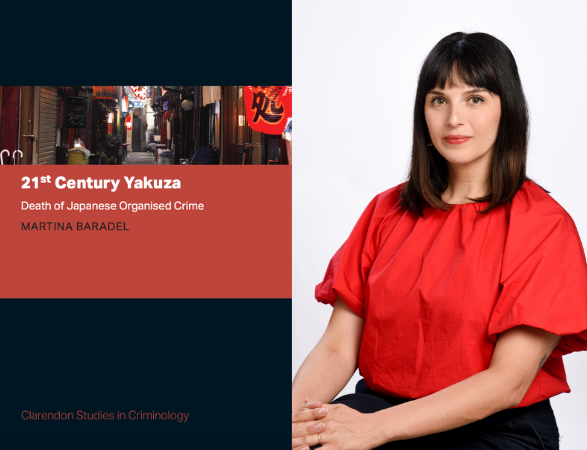
Martina Baradel explores the death of a mafia in new book
What happens when a mafia begins to die?
For decades, Japan's yakuza represented a distinctive form of organised crime. Unlike many criminal organisations that operate in secrecy, yakuza groups maintained offices, displayed their signs and symbols, and exercised authority openly in parts of Japanese society and markets.
Their visibility was a key component of how they governed markets, resolved disputes, and maintained their position within the underworld.
In 21st Century Yakuza: Death of Japanese Organised Crime, the Department's Martina Baradel examines the transformation and decline of this unique criminal institution. Drawing on years of fieldwork and interviews with active and former yakuza members, police officers, lawyers, journalists, and other key actors, the book traces how legal reforms, administrative restrictions, market restructuring, and changing social attitudes progressively eroded the foundations of yakuza power.
Rather than portraying the decline of the yakuza as a simple law-enforcement success story, the book analyses the broader consequences of dismantling a governance-oriented criminal organisation.
As the yakuza have lost their ability to regulate markets and exercise authority, the criminal landscape has become increasingly fragmented. New actors have emerged, but none have reproduced the organisational structure, legitimacy, or governance functions that once characterised the yakuza.
Combining ethnographic research with historical and sociological analysis, the book contributes to wider debates on organised crime, governance, legitimacy, and institutional change.
By examining not only how criminal organisations survive but also how they decline, 21st Century Yakuza offers a new perspective on the life cycle of mafia-type groups and on the changing nature of criminal power in contemporary Japan.
Martina Baradel is a Senior Research Fellow at Oxford and an Associate Professor at the Graduate School of Law, Nagoya University.
At Oxford, she is the recipient of an ERC Starting Grant for CrimCross, a five-year research project examining how organised criminal groups overcome cultural, linguistic, and legal barriers when expanding into foreign territories.
Focusing on the yakuza’s interactions with criminal groups in East and Southeast Asia, the project investigates how criminal organisations establish connections across borders, communicate across cultural and linguistic boundaries, and adapt to unfamiliar legal and social environments.
Original Publication
Baradel, M. (2026) 21st Century Yakuza: Death of Japanese Organised Crime. Oxford: Oxford University Press.