

This MPhil introduces students to contemporary theories and research methods at the intersection of Sociology and Demography, preparing students for both doctoral work and research-intense jobs.
Students are introduced to contemporary approaches to the study of population change and its consequences. These approaches explicitly join the macro approach of traditional demography with the multilevel, actor-oriented life course approach.
The MPhil curriculum emphasises:
- population-level analysis and demographic measures
- the life course approach
- sociological analysis as the key approach to explanation
- advanced quantitative methods
Who is this programme for?
This programme may be a good fit if you:
- Want to specialise in the study of population change and its social consequences
- Are preparing for doctoral study in Sociology, Demography or a related social science
- Enjoy working with quantitative data and developing advanced analytical and research skills
- Are interested in understanding social change through the combined perspectives of sociology and demography
- Have a background in sociology, economics, geography, public health, social policy, statistics or another social science with a strong methods component
Who will you be studying with?
Course Structure
This 21-month programme consists of four compulsory Core Papers, two Optional Papers, a Replication Project and a thesis.
The Core Papers are:
- Sociological Analysis, which develops intellectual skills in explaining social phenomena: identifying puzzles, developing theoretical explanations, and evaluating empirical evidence
- Demographic Analysis, which introduces students to current scientific debates on different components of population dynamics, and provides technical skills for computing demographic measures and models
- Life Course Research, which introduces students to the theory and methodological approaches of life course research
- Methods of Social Research, which introduces students to statistical methods and the research design process
Optional Papers can vary each year, but typically can include courses in advanced quantitative methods; political and civil conflict; social movements; social stratification; the sociology of gender; the sociology of cybersecurity; the sociology of mafias; and methods of causal inference.
Through choosing their Optional Papers and a related thesis topic, students can create their own specialised pathway during their degree, supported by expert supervision and teaching.
Example topics of focus include crime and governance; social inequality; political sociology; gender and family; time use research; demography; education; and quantitative methods.
The Replication Project and Thesis
MPhil students will undertake a Replication Project and a Thesis.
The Replication Project module aims to introduce students to the realities of empirical research through the mediums of replication and open science, with the objective being the replication and a modest extension of a piece of recently published work. Students are assessed by a paper detailing their attempt to replicate published research findings.
The MPhil Thesis consists of a new and substantial analysis of up to 30,000 words on a sociological and/or demographic topic, to be submitted by the end of the second year.
Text
The Student Experience
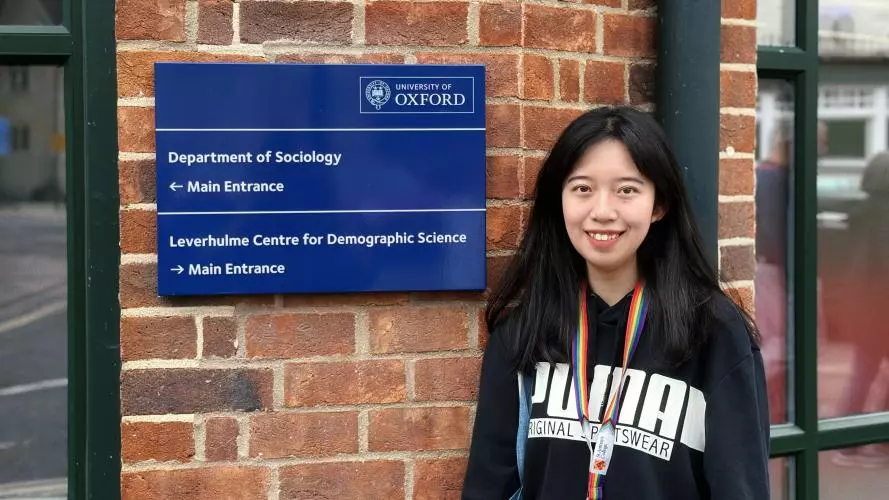
Why did you apply for the MPhil in Sociology and Demography?
I was attracted not necessarily by any one particular thing, but by the breadth of things the Department has to offer. Having the opportunity to interrogate a diverse set of social issues through theoretical and empirical inquiry, no less from seasoned professors who have spent a lifetime doing the same, was an incredibly enticing and humbling prospect.
What first attracted me to the Sociology Department at Oxford was its strong tradition of empirical research and analytical sociology. I also appreciate how the Department values both quantitative and qualitative methods and fosters research that is theoretically grounded yet deeply engaged with real-world social issues.



What have you enjoyed most about the programme?
The Department organises seminars every week where outstanding researchers share their studies. This provides students with insights into various cutting-edge studies in sociology. It’s not only engaging, akin to listening to stories, but also offers valuable learning opportunities.

What I like most about my course is its comprehensive curriculum. Whether you are like me and are entirely new to the social sciences, or are instead looking to deepen your social science skills even further, the course offers a multitude of academic opportunities to accommodate the diverse range of students.
After your Degree
Graduates of the MPhil in Sociology and Demography go on to careers in:
- Government departments and national statistical offices
- International organisations and NGOs
- Research institutes and think tanks
- Consulting, market research and health research
- Academia and doctoral study
The programme combines advanced quantitative methods with sociological and demographic theory, equipping graduates with the analytical and research skills needed for doctoral study and research-intensive careers across the public, private and third sectors.