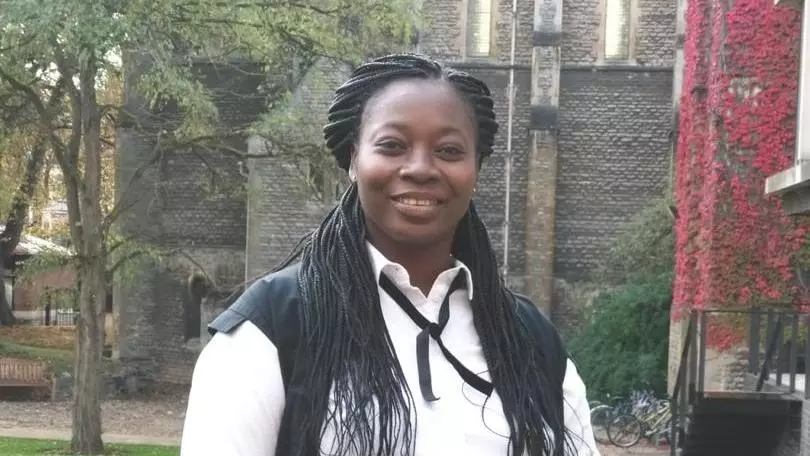

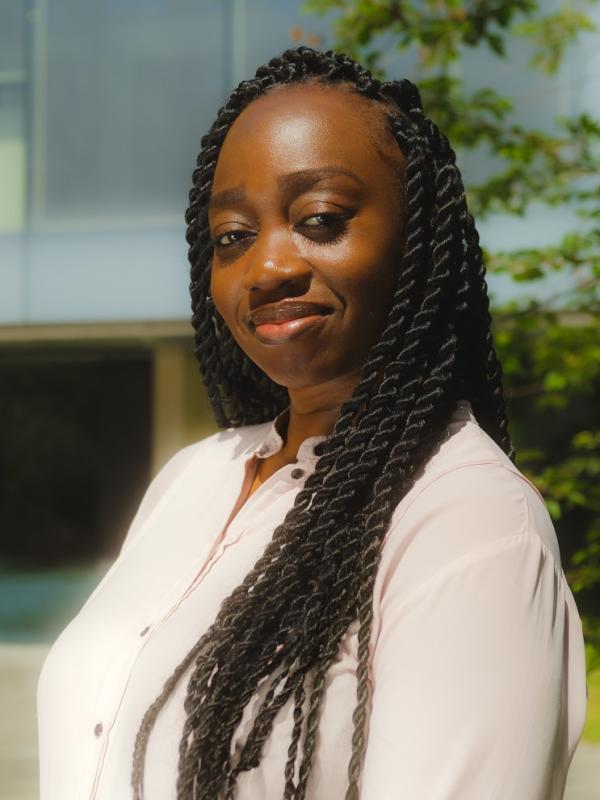
DPhil Student Spotlight: Cynthia Kwakyewah
Cynthia is completing her DPhil under the supervision of Professor Leigh Payne. A member of St Antony's College, she joined the Department in 2018 after studying a BA in International Development Studies and an MA in Interdisciplinary Studies at York University, Toronto.
Why study Sociology?
While I have an interdisciplinary educational background, my knowledge of sociological theories and approaches were limited. Yet I was intrigued by the idea of taking a sociological lens on a business and human rights research question.
My current doctoral project employs concepts and theories from the sociology of organisations to make valuable contribution to the business and human rights literature. Looking back, I'm glad to have chosen sociology. It has given me the opportunity to broaden my academic horizon, both methodologically and theoretically.
What first attracted you to the course at Oxford?
My supervisor, Professor Leigh Payne. I was particularly drawn to her approach to constructing empirically driven theory. Before I approached Leigh for supervision, I contacted a former student who testified about Leigh's amazing supervision style. And she wasn't exaggerating!
I'm very fortunate to be under Leigh's wings. She has challenged me intellectually and shown immense support throughout my DPhil journey.
Where do your research interests lie?
My research interests include business and human rights, environment and business, corporate social responsibility, sustainable development, natural resources management in Africa, civil society activism and social justice issues.
Has any of your research been published?
Yes! I have published parts of my MA thesis as journal articles and a book chapter with my former supervisor:
- Idemudia, U., Kwakyewah, C. & Muthuri, J. M. (2020). Mining, the environment and human rights in Ghana: An area of limited statehood perspective. 'Business Strategy & the Environment'. 29(7), 2919-2926.
- Idemudia, U. & Kwakyewah, C. (2019). Strengthening human rights responsibilities: The experience in Ghana's gold mining industry. In Matthias Hofferberth (ed.), 'Corporate Actors in Global Governance: Business as Usual or New Deal' (pp. 51-74). Advances in International Political Economy Series. Boulder: Lynne Rienner Publishers.
- Kwakyewah, C. & Idemudia, U. (2017). Canada-Ghana engagements in the mining sector: Protecting human rights or business as usual?. 'The Transnational Human Rights Review'. 4, 146-170.
Recently, I also published a book chapter:
- Kwakyewah, C. (2022). De-constructing socio-spatial injustices: Urban poverty among Blacks in Toronto. In S.N. Dlamini and A. Stienen (eds.), 'Spatialized Injustices in the Contemporary City: Protesting as Public Pedagogy' (pp. 17-41). Abington: Routledge.
The chapter explores why Toronto's Black population is concentrated in enclaves defined as at-risk or priority neighbourhoods by looking at the intersection of race, social class, and space. Drawing on the Black Lives Matter movement and other forms of mobilisation, the chapter shows that Black Canadians have confronted racial discrimination and spatial entrapment throughout history.
What did you do before starting the DPhil?
Following my undergraduate studies, I worked as a Research Associate for four years on a variety of projects at York University in Canada. These included 'Africapitalism: The role of the private sector in Africa's development' (Social Science Department), 'Canada's Rights Role in Anglophone Africa' (Osgoode Hall Law School) and 'Youth in Politics, Canada' (Faculty of Education).
What do you hope to do when you finish your course?
After I finish my DPhil, I hope to pursue a career in academia.
What piece of advice would you give to prospective students?
Always remember that embarking on a doctoral study is a journey. As with every journey we plan, and often evoke, images of the destination in our minds.
While it is important to follow the plan as much as possible and keep your eyes on the prize, you must also be open-minded, flexible, and adaptable to change.
Expect the unexpected and embrace the process of intellectual, professional, and personal growth.
What do you enjoy the most about living or studying at Oxford?
I appreciate the diversity in student population and varying opportunities for student engagement. There are so many events, research projects and initiatives happening at Oxford. We are spoiled with choices.
For instance, I am currently one of the team lead for a cultural heritage project entitled 'A History of Ordinary People in Africa (HOPIA)', funded by TORCH and the Oxford African Studies Centre. Using oral history methodology, the project emphasises the social experience of everyday life and reveals how ordinary people participate in the process of social change.
Needless to say, I also love the architecture here. I'm quite fascinated by the various historical buildings and the University's dedication to preserving this history.
You can get in contact with Cynthia here.