
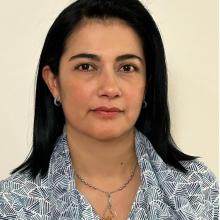
Alum Nancy Tapias Torrado wins ISA Human Rights Award for DPhil Dissertation
About Nancy's dissertation, the awarding committee said:
Indigenous women activists, the key actors in this dissertation, must contend with three oppressive structures and systems: racism, patriarchy, and capitalism. The author makes these activists visible in a context where many conspire to make them invisible and ineffective.
The committee praised Nancy's 'novel framework' - the braid of action - which she used to explain the exact circumstances in which Indigenous women-led civil society activism will be successful, influencing corporate practices and improving human rights.Nancy explained that four actions, woven together, produce change: "(1) transforming the territory into power; (2) Indigenous women's effective leadership; (3) human rights framing; and, (4) reacting to a grave violation overtly involving corporations." Any weak 'strands' would hamper the success of the activism.
By focusing on the agency of the Indigenous women, the dissertation elaborated on the centrality of claiming and defending territory as a first strand of the action braid. Leadership, human rights framing, and strategic responses to human rights violations are then essential complements for successful mobilisation to change corporate behaviour.
After receiving the award, Nancy said:
I am very grateful and humbled to receive the Best Human Rights Dissertation Award from the International Studies Association, the oldest and widest association dedicated to international studies.
It is a very important personal achievement and a recognition of incredible significance, as I also take it as an acknowledgement of the crucial contributions of Indigenous women and the mobilisations they lead.
They are not only defending their peoples' existence, subsistence and rights from abuses committed in connection to mega-projects but also the most biodiverse and fragile ecosystems that are of fundamental importance for the sustainability of the world, especially now, in the current climate crisis.
I am honoured that Indigenous women leaders, their organisations, and many others supporting them have shared their knowledge and experiences with me.
Although there were many wonderful moments, there were also very difficult challenges. In this regard, I am deeply moved by the fact that I will receive this Award in March, the exact month when seven years ago - the day after we talked about her participation in my doctoral study - Indigenous Lenca leader Berta Cáceres Flores was murdered in her house in Honduras.
This award is a reaffirmation of her impact, voice, and that of many other Indigenous women leaders across the region.
Original Publication
Nancy R. Tapias Torrado. (2020) 'Indigenous Women Leading the Defence of Human Rights from the Abuses by Mega-Projects in Latin America, in the Face of Extreme Violence' (University of Oxford: DPhil thesis)